
Beach access in Mauritius is a topic many tourists ask me about before their trip. If you’re planning a holiday here, it’s important to know that the Mauritian government has reaffirmed your right to enjoy the island’s iconic beaches without being turned away by ‘private beach’ notices. Understanding the laws and what to do if someone tries to stop you will help you make the most of your visit.
Key details for tourists
- Any sign prohibiting public access to beaches in Mauritius is illegal, the government confirms.
- The public (both citizens and visitors) has the right to walk, swim, picnic, and relax on all beaches free of charge.
- If someone stops you from accessing the beach, you can report it to the Beach Authority or the Mauritius Police Force.
- Obstructing public beach access is a criminal offense, with fines up to Rs 10,000 per Article 110 of the Criminal Code (Supplementary) Act.
- This guidance is based on laws including the Pas Géométriques Act of 1874, the Beach Authority Act of 2002, and recent government statements (June 2026).
Understanding Beach Access Laws in Mauritius
Mauritius is famous worldwide for its golden beaches and turquoise lagoons. These natural wonders are a big reason the island draws visitors from Europe and beyond, especially in your summer months when Mauritius is delightfully cool and dry. But there’s often confusion about which parts of the coastline you can enjoy. That’s because some beachfront property owners put up signs claiming that certain stretches are ‘not public beach’ or even threatening you with legal action.
Here’s what really matters: according to the government (and the law), these signs are not valid. The Mauritian Ministry of Housing and Lands, led by Minister Shakeel Mohamed, emphasizes that:
Mauritius Trip Planner
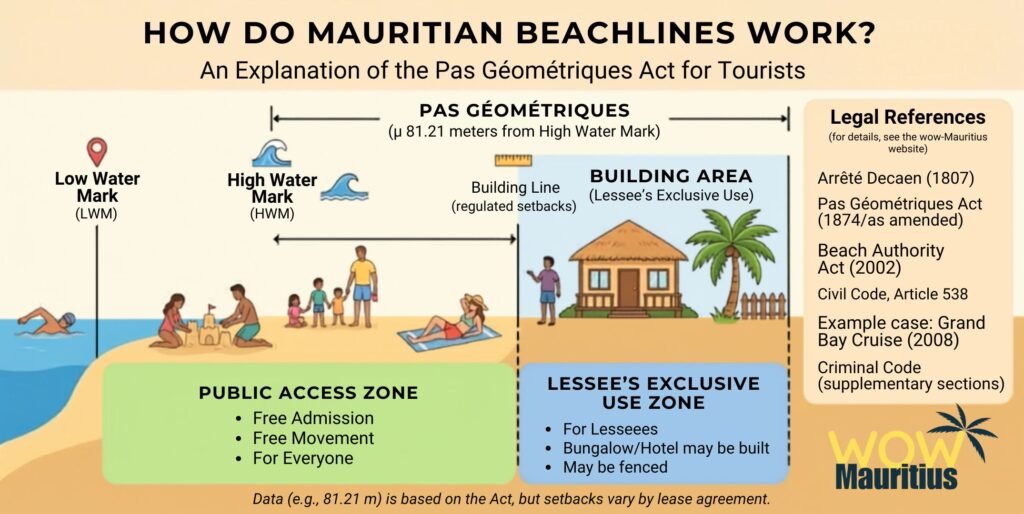
- Beachfront land leased from the state does not become private property. Leaseholders cannot block public access to the shore.
- The beach and the adjacent strip of state land (the ‘Pas Géométriques’) are for the public’s use under both the Civil Code and dedicated national laws.
- The 2008 Supreme Court decision in the Grand Bay Cruise Ltd v Ocean Blue Island Company Ltd case reaffirmed that beaches are part of the public domain.
What the Laws Mean For Your Holiday
This means you do not need to pay to sit on the sand, swim, or enjoy the seaside. You cannot be forced out by someone citing private ownership, unless you stray into their actual building or cordoned-off area on leased land away from the shoreline itself. The law draws a careful distinction, the sand and shore are for all.
How to Enjoy Mauritian Beaches as a Visitor
As someone living in Mauritius, I’ve seen how misunderstandings about ‘private beaches’ can sour a perfectly good beach day for travelers. Here’s how you can confidently make use of your rights:
- If you see a sign denying public access to a stretch of sand or warning about trespassing between a hotel/villa and the water, know that these are not supported by law.
- You can walk along the entire coastal strip, as long as you’re on the beachfront or in the area commonly considered ‘beach’ (the sand and first strip of state land before the built environment).
- Feel free to spread your towel, swim, or have a picnic. This is for both Mauritians and tourists alike.
- Hotels, resorts, and restaurant service areas themselves are private, but the sand in front of them remains public domain.
What To Do If You’re Challenged
- Stay calm and politely inform the person that Mauritian law guarantees free access to the beach for everyone.
- If you feel threatened or physically prevented from accessing the beach, immediately report the incident to the Beach Authority or the Mauritius Police Force.
- You may also take a photo of the sign and the obstructed area to share with authorities.
It’s reassuring to know the police have the power to intervene. The government urges anyone stopped from accessing a beach to come forward, so if your plans ever hit a wall (literally or figuratively), there’s recourse.
Why This Matters: Real Experiences and Practical Advice
Tourists sometimes worry when they see ‘private beach’ markers near luxury resorts or villas, especially on famous beaches like Belle Mare, Flic en Flac, or Le Morne (one of which recently ranked among the world’s top 50). In reality, while hotel sunbeds and service areas are reserved for guests, the sand and sea in front of them are yours to enjoy as well.
If you want more on beaches by region, see our guides like Belle Mare Beach Mauritius: Complete Local Guide or Île aux Cerfs Beach Mauritius: Crystal Waters, Soft Sands & Essential Guide. Each covers both facilities and free-access areas in detail.
Here are a few more practical points:
- Resort facilities (bars, pools, private cabanas) might be restricted, but strolling or sitting on the beach is not.
- You don’t need to justify your presence or show ID at the beach.
- Always show respect for local customs: avoid loud music, keep beaches clean, and follow safety and swimming flags.
- If in doubt about a spot, ask a local or look for publicly marked pathways to the shore. Avoid walking within private gardens or inside resort boundaries, which are separate from the public sand.
Penalties for Blocking Beach Access
The Mauritian government does not take unlawful restrictions lightly. According to Article 110 of the Criminal Code (Supplementary) Act, anyone who prevents public passage along the shore can be fined up to Rs 10,000. The police are fully empowered to act on your behalf if you’re harassed, and authorities encourage you to report such incidents promptly.
Final Thoughts and Planning Tips
I always recommend bringing sun protection, water, and snacks, especially when exploring the less-developed beaches. During Mauritius’s winter (June, September), the weather is at its driest and coolest, ideal for swimming and strolling miles along the coast.
If you want to explore several beaches in one trip, renting a car gives you the most freedom. Public beaches often have car parks, basic toilets, and sometimes lifeguards. As a tourist, your right to access and enjoy these natural wonders is protected in law and practice, so get out there and experience the best of island life!
For further official information, consult the Mauritius Beach Authority and Mauritius Now, Beaches for detailed area access.
Source: defimedia.info
Frequently Asked Questions
Can tourists use any beach in Mauritius?
Yes, Mauritian law ensures that both locals and visitors can access, walk, swim, and relax on all public beaches free of charge.
What should I do if I’m stopped from accessing a beach?
Stay calm, inform the person that beach access is public by law, and report the incident to the Beach Authority or the Mauritius Police Force.
Are hotel beachfronts private?
Only hotel facilities (like sunbeds or pools) are private, but the sand and the sea in front remain public and accessible to everyone.
Are ‘private beach’ signs legal in Mauritius?
No, the government states these signs are illegal and have no legal standing. Beachfront land leased from the state must remain open to the public.